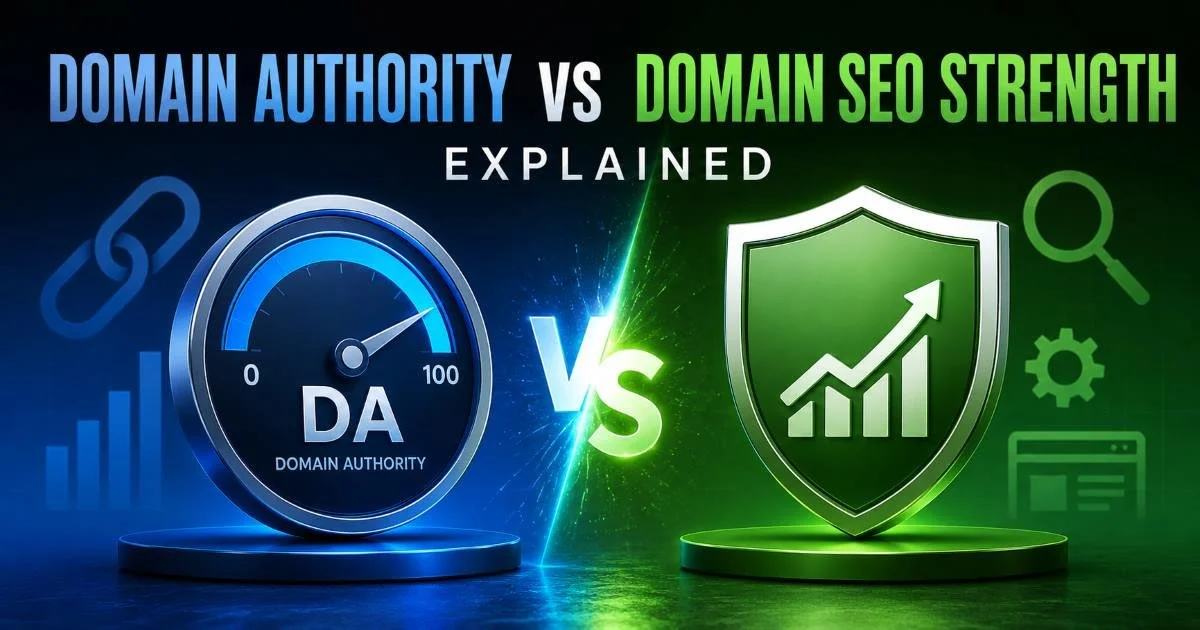
Domain Authority vs Domain SEO is a comparison that every digital marketer eventually needs to understand. Both metrics aim to predict how well a website will perform in search engine results, but they approach the problem from different angles and with different methodologies. Domain Authority, developed by Moz, has become one of the most widely referenced third-party metrics in the industry.
Meanwhile, the broader concept of domain SEO strength takes a more holistic view, incorporating factors beyond just backlinks. Choosing between these frameworks affects how you audit websites, prioritize improvements, and report to stakeholders.
Understanding what domain SEO strength really means and how it works is the first step toward making an informed decision. The stakes are real: misinterpreting either metric can lead to wasted budgets and misguided strategy.
Key Takeaways
- Domain Authority measures link profile strength on a 1 to 100 logarithmic scale.
- Domain SEO strength evaluates backlinks, content, technical health, and keyword performance together.
- Neither metric is used directly by Google's ranking algorithm.
- Combining both approaches gives the most accurate picture of ranking potential.
- Regular SEO audits should track multiple metrics rather than relying on a single score.
What Each Metric Actually Measures
Domain Authority: The Link-Focused Score
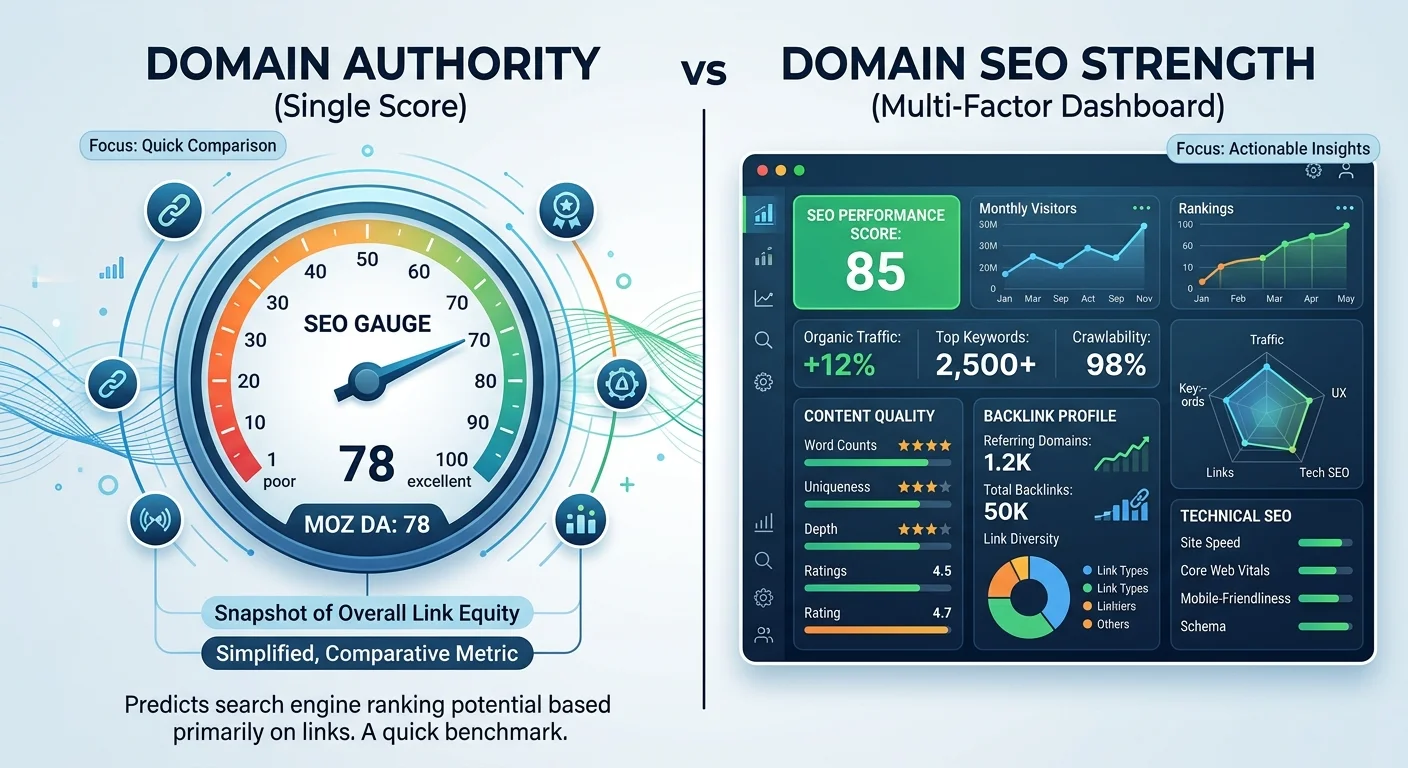
Domain Authority (DA) is a proprietary metric created by Moz that scores websites from 1 to 100. The score is calculated primarily through backlink analysis, examining the quantity and quality of external links pointing to a domain. Moz uses a machine learning model trained against actual Google search results to calibrate the score. A site like Wikipedia scores in the high 90s, while a brand-new blog might start at 1 or 2.
The scale is logarithmic, meaning it is significantly harder to move from 70 to 80 than from 20 to 30. DA relies heavily on Moz's Link Explorer index, which tracks linking root domains, total backlinks, and the authority of those linking sites. The metric updates regularly as Moz recrawls the web and refines its algorithm. It is worth noting that DA does not factor in on-page content quality, site speed, or technical SEO health.
Because DA focuses almost exclusively on link signals, it offers a clean, easy-to-understand snapshot of a site's backlink profile. However, this narrow focus is both its greatest strength and its most significant limitation. A site could have excellent DA while suffering from poor technical SEO, thin content, or keyword cannibalization. Experienced SEO professionals recognize that DA is one data point among many, not a comprehensive health check.
Domain SEO Strength: The Full Picture
Domain SEO strength is a broader concept that evaluates a website's overall search optimization across multiple dimensions. Rather than relying on a single backlink-based score, it incorporates technical health, content relevance, keyword ranking distribution, domain age, and link authority together. Tools that measure domain SEO strength typically run a comprehensive audit rather than generating a single number. This approach mirrors how search engines actually evaluate websites.
Technical factors like crawlability, site architecture, Core Web Vitals, and mobile responsiveness all contribute to domain SEO strength. Content signals, including topical authority, keyword targeting accuracy, and content freshness, round out the assessment. If you are looking for tools that aggregate these signals programmatically, platforms like the best SEO APIs available can pull data across multiple dimensions simultaneously. The result is a multifaceted view that single-metric scores simply cannot replicate.
Run a full SEO audit quarterly to track domain SEO strength changes across all dimensions, not just backlinks.
The tradeoff with this holistic approach is complexity. There is no universally agreed-upon formula for domain SEO strength, and different tools weight factors differently. This means comparing two websites requires interpreting multiple data points rather than glancing at a single number. For sophisticated teams, that complexity is a feature, not a bug. For quick competitive benchmarks, it can feel like information overload.
Accuracy and Predictive Power
How Well DA Predicts Rankings
Moz has been transparent that Domain Authority is designed to predict ranking likelihood, not guarantee specific positions. In correlation studies, higher DA scores generally correspond with better rankings across large datasets. However, individual queries tell a different story. A page on a DA 30 site can absolutely outrank a DA 70 competitor if the content is more relevant and better optimized for a specific keyword. DA works best as an aggregate predictor, not a page-level one.
One persistent issue is DA manipulation. Because the metric relies on backlinks, it can be inflated through link schemes, PBNs (private blog networks), and aggressive guest posting. Moz has taken steps to combat spam through its Spam Score metric, but inflated DA scores remain common, particularly in industries like gambling, payday loans, and certain affiliate niches. This means a raw DA number should always be verified through manual backlink analysis before drawing conclusions.
Google has repeatedly stated that it does not use Domain Authority or any third-party score in its ranking algorithm. John Mueller from Google has called DA a "made-up metric" in the context of how Google processes rankings. That does not make DA useless; it simply means marketers should understand its role as an approximation tool rather than treating it as a mirror of Google's internal scoring. The gap between DA and actual search performance can be significant for individual domains.
SEO Strength as a Ranking Predictor
Domain SEO strength, by incorporating more ranking factors, tends to offer better predictive accuracy for individual sites. When you account for technical health alongside authority signals, you catch problems that DA alone would miss entirely. A domain with strong backlinks but a broken XML sitemap, slow load times, and duplicate content will underperform its DA score. Conversely, a technically excellent site with moderate backlinks can punch well above its weight class.
The challenge is that multi-factor analysis requires more expertise to interpret. A single DA score is easy to put in a spreadsheet and compare across 500 domains. A comprehensive SEO strength assessment for each of those 500 domains demands significantly more time and tooling. Teams running large-scale competitive analysis often start with DA as a screening filter, then apply deeper SEO strength analysis to their top competitors. This layered approach balances efficiency with accuracy.
"A high Domain Authority score without strong technical SEO and content strategy is like having a powerful engine in a car with flat tires."
Practical Use Cases for Marketers
When Domain Authority Shines
Domain Authority is most valuable for quick competitive benchmarking, link building prospecting, and reporting to non-technical stakeholders. When evaluating potential link-building targets, DA provides a fast way to assess whether a site is worth pursuing. A backlink from a DA 60 site generally carries more weight than one from a DA 15 site, all else being equal. For agency reporting, DA offers a clean trend line that clients can understand without deep SEO knowledge.
DA also works well for tracking your own domain's link profile growth over time. If your DA climbs from 25 to 35 over six months, you know your link building and content marketing are generating results. The metric is particularly useful for comparing domains within the same niche, where competitive conditions and link availability are relatively similar. In PR and outreach contexts, DA remains the de facto standard for evaluating publication quality, even though it is an imperfect proxy.
DA scores fluctuate with Moz index updates. A sudden drop does not always indicate a real problem with your site.
When SEO Strength Analysis Wins
Full domain SEO strength analysis becomes essential when you need actionable recommendations, not just a scorecard. An SEO audit that examines technical infrastructure, content gaps, keyword ranking distribution, and backlink quality produces a roadmap of specific improvements. This is the approach you need before a site migration, after a traffic drop, or when planning a content strategy overhaul. Single metrics cannot guide these kinds of decisions with enough precision.
Enterprise teams managing large websites benefit particularly from comprehensive strength assessments. A site with 50,000 pages might have excellent authority but suffer from crawl budget waste, orphaned pages, or poor internal linking. Only a multi-factor analysis catches these issues. For e-commerce sites, where technical SEO directly impacts revenue through product page indexation and site speed, a holistic strength evaluation is not optional. It is the baseline for competent SEO management.
Head-to-Head: Domain Authority vs Domain SEO Strength
When comparing Domain Authority vs Domain SEO directly across key criteria, the differences become stark. DA excels in simplicity and widespread adoption. Virtually every SEO tool supports it, most marketers understand it, and it requires zero configuration. Domain SEO strength wins on comprehensiveness, accuracy for individual sites, and actionability. The table below summarizes these differences across the dimensions that matter most for practical decision-making.
| Criteria | Domain Authority (Moz) | Domain SEO Strength |
|---|---|---|
| Primary Data Source | Backlink profile | Backlinks, technical, content, keywords |
| Score Format | Single number (1-100) | Multi-factor assessment |
| Ease of Use | Very easy | Moderate to complex |
| Predictive Accuracy | Good for aggregate trends | Better for individual domains |
| Manipulation Risk | Moderate (link schemes) | Lower (harder to fake all signals) |
| Actionability | Low (score only) | High (specific recommendations) |
| Best For | Quick benchmarks, link prospecting | Audits, strategy, site improvements |
The reality is that most effective SEO workflows use both. You might use DA to screen competitors and identify link targets, then apply a full domain SEO strength analysis to your own site and your top three rivals. This combination gives you the speed of a single metric where speed matters and the depth of comprehensive analysis where depth matters. Treating Domain Authority vs Domain SEO as an either/or choice creates an unnecessary blind spot.
Never rely on a single metric when making significant SEO investment decisions. Cross-reference DA with traffic data, keyword rankings, and technical audits.
The tools you choose matter, too. Some platforms now combine traditional authority scores with broader SEO health indicators, creating hybrid dashboards that bridge the gap. Whether you build custom reports through APIs or use all-in-one platforms, the goal is the same: getting the most accurate and complete picture of a domain's true ranking potential. Smart marketers pick the right tool for the right question, rather than forcing one metric to answer everything.
For agencies reporting to clients, a practical approach is to track DA as a headline metric while using domain SEO strength analysis to drive the actual strategy. This satisfies the client's desire for a simple progress indicator while giving the team the detailed intelligence needed to make smart optimization choices. The keyword ranking improvements and traffic growth that result from strength-based strategies will, over time, be reflected in DA gains as well.
Frequently Asked Questions
?How do I improve Domain SEO strength beyond just building backlinks?
?Is Moz DA more reliable than a full domain SEO strength audit?
?How long does it realistically take to raise a low DA score?
?Can a high DA site still rank poorly due to keyword cannibalization?
Final Thoughts
The Domain Authority vs Domain SEO debate is not about picking a winner. It is about understanding when each approach serves you best. DA gives you speed and simplicity for competitive screening.
Domain SEO strength gives you the depth needed to build and execute real strategies. Use both, but never mistake a single score for a complete diagnosis. The best SEO professionals treat metrics as tools in a toolkit, selecting the right one for each specific task.
Disclaimer: Portions of this content may have been generated using AI tools to enhance clarity and brevity. While reviewed by a human, independent verification is encouraged.