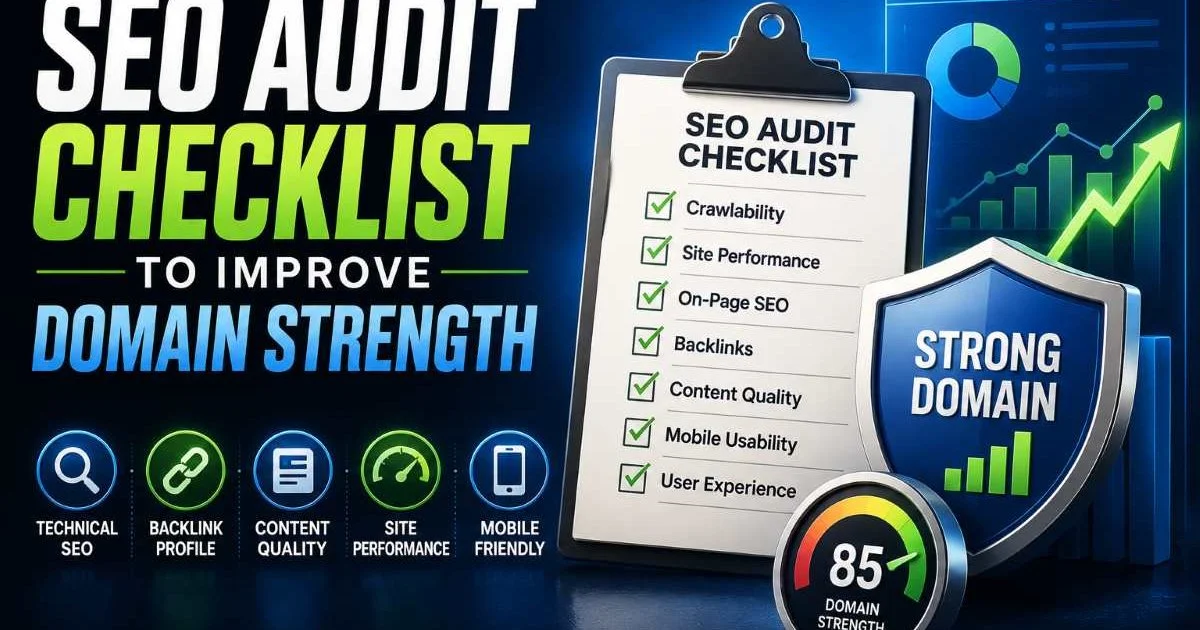
An SEO audit is the single most effective way to measure and improve your domain's strength, ranking potential, and overall search visibility. Without a structured audit process, even experienced digital marketers miss technical gaps, weak backlink profiles, and keyword opportunities hiding in plain sight.
Domain authority, backlink analysis, and keyword ranking are interconnected signals that search engines use to evaluate your site, and understanding how they relate is the foundation of any serious optimization effort. If you want a deeper understanding of what domain SEO strength actually means and how it's calculated, our guide on what domain SEO strength is and how it works is an excellent starting point.
This checklist walks you through a practical, repeatable audit process designed for professionals who want measurable gains. Follow these four steps to diagnose weaknesses, prioritize fixes, and build a stronger domain over time.
Key Takeaways
- A structured SEO audit identifies technical, content, and authority gaps simultaneously.
- Backlink analysis reveals toxic links that actively suppress your domain authority.
- Keyword ranking audits expose content cannibalization and missed search intent opportunities.
- Technical SEO health directly impacts crawlability, indexing speed, and ranking stability.
- Regular quarterly audits prevent slow domain strength erosion before it becomes visible.
Step 1: Audit Your Technical SEO Foundation
Crawlability and Indexing
Technical SEO is the infrastructure layer that determines whether search engines can even access and understand your content. Start by running a full site crawl using tools like Screaming Frog or Sitebulb. You're looking for broken links (4xx errors), server errors (5xx), redirect chains longer than two hops, and orphan pages that no internal link points to. A site with hundreds of crawl errors is hemorrhaging its crawl budget, which means Google may never discover your most important pages.
Check your robots.txt file against your actual sitemap. A surprising number of sites accidentally block important directories or include URLs in their sitemap that robots.txt disallows. Verify that your XML sitemap is current, contains only canonical, indexable URLs, and is submitted in Google Search Console. Look at the "Pages" report in Search Console to identify pages with "Crawled, currently not indexed" status, which often signals thin content or quality issues.
Run a "site:yourdomain.com" search in Google and compare the result count against your sitemap URL count to quickly spot indexing discrepancies.
Core Web Vitals and Page Speed
Google's Core Web Vitals (LCP, INP, CLS) are confirmed ranking factors, and poor scores directly weaken your domain's competitive position. Use PageSpeed Insights to test your five highest-traffic templates, not just the homepage. Common culprits include unoptimized images, render-blocking JavaScript, and excessive third-party scripts. Aim for LCP under 2.5 seconds, INP under 200 milliseconds, and CLS below 0.1.
Mobile usability deserves separate attention. Test your site on actual devices, not just Chrome DevTools emulators. Check for viewport issues, tap target spacing, and font readability. Schema markup validation is another often-skipped step. Run your key page types through Google's Rich Results Test to confirm structured data parses correctly and qualifies for enhanced SERP features.
Step 2: Analyze Your Backlink Profile for Domain Strength
Identifying Toxic Links
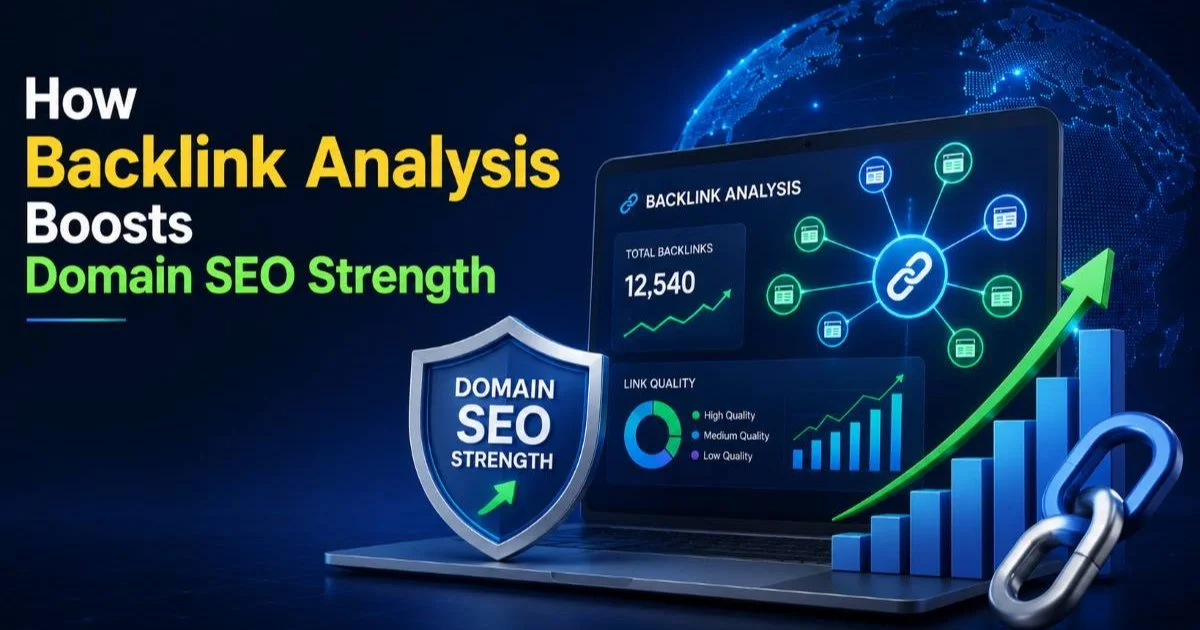
Your backlink profile is one of the strongest signals influencing domain SEO strength, and a thorough backlink analysis directly boosts your domain's ranking potential. Export your complete backlink data from Ahrefs, Semrush, or Moz, and sort by referring domain authority. Look for patterns: clusters of links from low-quality directories, foreign-language spam sites, PBN footprints, or exact-match anchor text that appears manipulative. Any domain linking to you with a spam score above 60% in Moz warrants investigation.
Create a disavow file for genuinely toxic links, but exercise caution. Google's algorithms are generally good at ignoring low-quality links, so disavowing aggressively can sometimes remove links that were actually passing value. Only disavow when you have clear evidence of a negative SEO attack or a manual penalty notification. Document every disavow decision with the reason so you can revisit later.
Never disavow links from legitimate sites just because they have low domain authority. Small niche blogs often pass relevant topical authority that metrics tools undervalue.
Building Quality Over Quantity
After cleaning up toxic links, evaluate the quality distribution of your remaining profile. A healthy backlink profile shows diversity across referring domains, anchor text types, and link placement (contextual editorial links versus footer or sidebar links). If more than 30% of your anchor text is exact-match commercial keywords, that's a red flag Google's Penguin algorithm watches for. Natural profiles typically show 40 to 60% branded anchors, 20 to 30% naked URLs, and the rest spread across partial match and generic terms.
Compare your backlink velocity against competitors. If a rival gained 200 referring domains last quarter while you gained 30, that gap in link acquisition speed explains ranking differences better than any on-page factor. Tools like Ahrefs' "Competing Domains" report reveal which sites link to your competitors but not to you, giving you a targeted outreach list. Understanding how domain authority compares to domain SEO strength helps you interpret these metrics without overrelying on any single score.
Step 3: Evaluate Keyword Ranking Performance
Keyword ranking analysis tells you where your content actually stands in search results, not where you hope it stands. Pull your ranking data from Google Search Console (for real impression and click data) and cross-reference it with a rank tracker like Semrush or Ahrefs. Focus first on keywords ranking in positions 4 through 20, because these represent your highest-ROI optimization opportunities. A page sitting at position 8 needs far less work to reach the top 3 than a page nowhere near page one.
Group your keywords by search intent: informational, navigational, commercial, and transactional. Many SEO professionals discover during this step that their content skews heavily informational while their competitors dominate commercial intent terms. Understanding how keyword ranking impacts domain SEO strength reveals why targeting a balanced intent mix is essential for building overall authority. Map each target keyword to a specific URL and note whether that URL actually ranks, or whether Google chose a different page from your site.
Content Gap and Cannibalization Checks
Keyword cannibalization is one of the most common yet overlooked problems in mid-size sites. It happens when multiple pages target the same primary keyword, forcing Google to choose between them (often picking the weaker one). Search Console's performance report filtered by query will show you if two or more URLs receive impressions for the same term. The fix usually involves consolidating content, adding canonical tags, or differentiating the search intent each page targets.
| Keyword Position | Priority Level | Recommended Action | Expected Effort |
|---|---|---|---|
| 1-3 | Maintain | Protect with fresh content updates, monitor SERP features | Low |
| 4-10 | High | Optimize on-page elements, improve internal linking | Medium |
| 11-20 | Medium | Add content depth, earn 2-3 quality backlinks | Medium-High |
| 21-50 | Low | Reassess intent alignment, consider content rewrite | High |
| 50+ | Evaluate | Determine if the page is worth keeping or should be pruned | Variable |
Run a content gap analysis by comparing your keyword universe against three to five direct competitors. Look for high-volume terms they rank for that you have no content addressing. These gaps often represent entire topic clusters you've neglected. Prioritize gaps where you already have topical relevance on your site, because creating content in adjacent topic areas signals expertise to Google's algorithms faster than branching into entirely new subjects.
"The most valuable finding in any keyword audit is not what you rank for, but what you should rank for and don't."
Step 4: Benchmark Domain Authority Metrics and Track Progress
Domain authority metrics from Moz, Ahrefs (Domain Rating), and Semrush (Authority Score) each use different methodologies, but tracking them over time gives you a relative performance indicator. Record your current scores alongside three to five competitors. The absolute number matters less than the gap between you and whoever ranks above you. If your Domain Rating is 42 and the top three competitors for your target keywords average 58, you know exactly the authority gap your link building needs to close.
Domain authority scores from third-party tools are approximations, not Google ranking factors. Use them as directional benchmarks, not absolute targets.
Beyond third-party scores, track first-party signals that reflect genuine domain strength. These include total indexed pages, referring domain growth rate, organic traffic trend, and branded search volume. Branded search volume is a particularly underappreciated metric because it indicates real-world brand awareness, something Google increasingly values. If people search for your brand name alongside industry terms, that sends strong trust signals to search engines.
Setting Up Ongoing Tracking
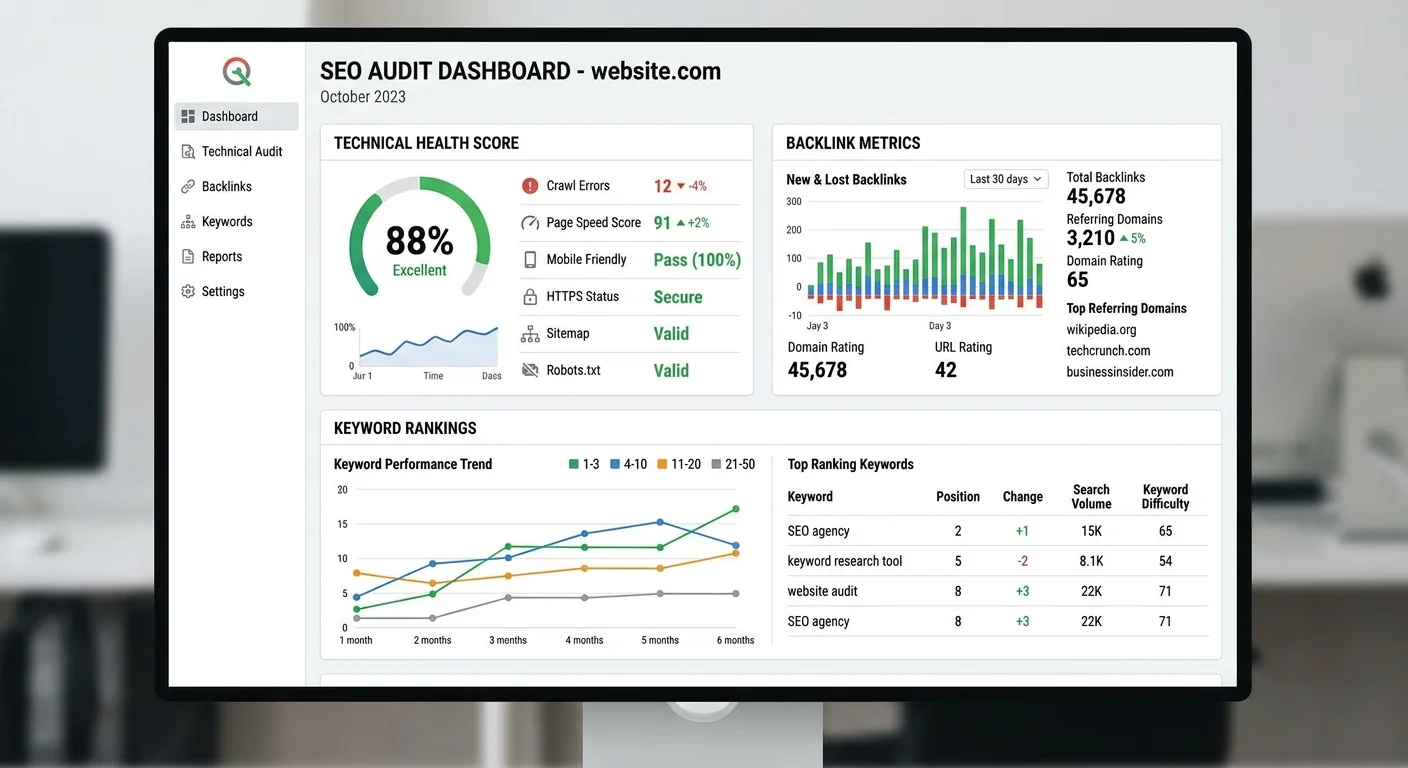
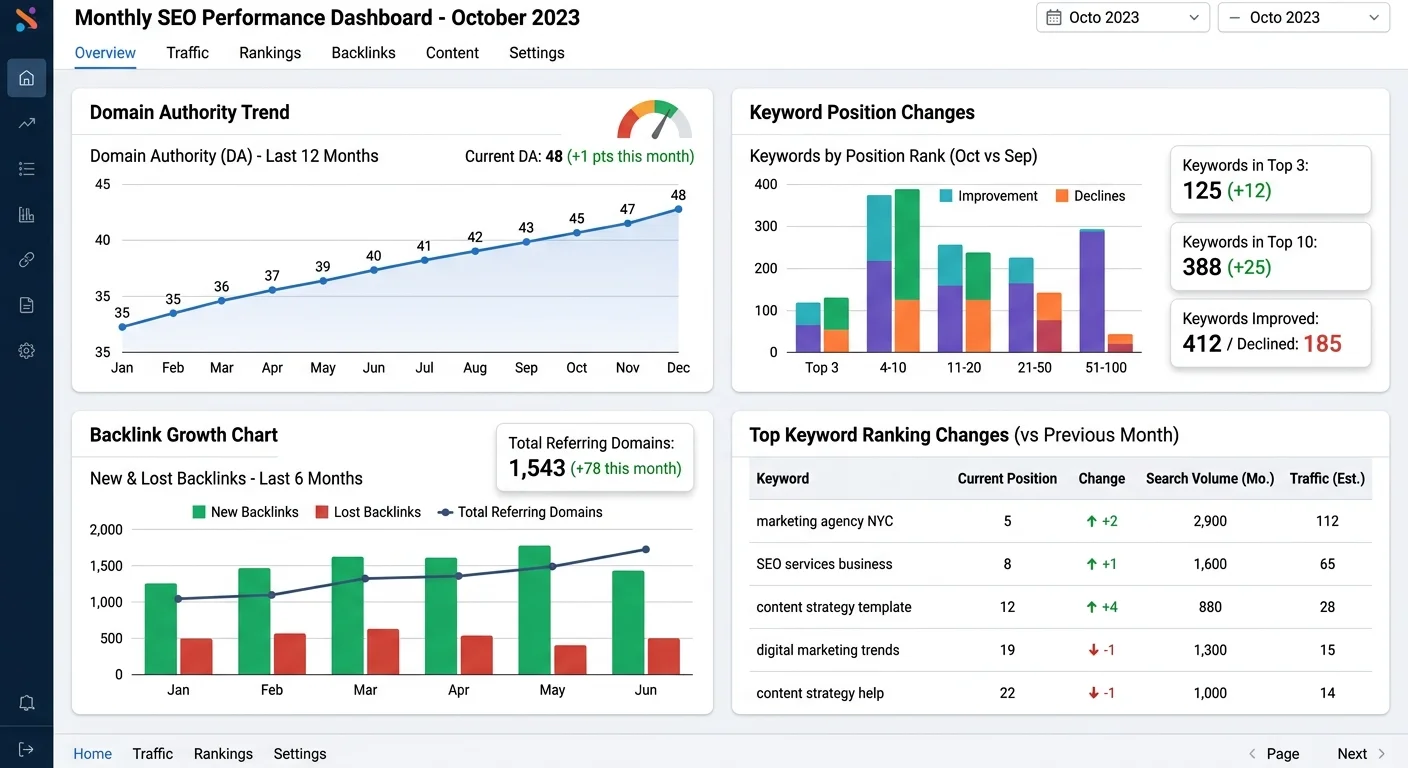
Build a monthly audit dashboard that combines technical health scores, backlink profile changes, keyword ranking movements, and domain authority metrics in one view. Tools like Looker Studio (connected to Search Console and your rank tracker API) can automate this reporting. Monitoring AI agents can also help you maintain oversight without manual effort; platforms for AI agent monitoring have matured significantly and can flag anomalies in your SEO data in real time.
Set quarterly audit milestones with specific targets: reduce crawl errors by 50%, gain 20 new referring domains, move 10 keywords from page two to page one. Without concrete goals, audits become academic exercises rather than growth drivers. Share your audit findings across your team with clear ownership for each action item. The audit itself creates zero value; only the follow-through does. Archive each quarter's data so you can measure year-over-year trajectory and identify seasonal patterns in your domain's SEO performance.
Frequently Asked Questions
?How do I find and fix toxic backlinks hurting my domain authority?
?How often should I run a full SEO audit to prevent domain erosion?
?Is Screaming Frog better than Google Search Console for crawl audits?
?Does a high DA score guarantee a #1 ranking in Google search results?
Final Thoughts
A thorough SEO audit is not a one-time project but a recurring discipline that compounds in value. Each pass through this checklist, from technical health through backlink analysis, keyword ranking evaluation, and domain authority benchmarking, builds institutional knowledge about your site's strengths and weaknesses.
The sites that consistently outperform competitors are rarely the ones with the biggest budgets; they're the ones that audit systematically and execute relentlessly on findings. Start your first full audit this week, set your quarterly cadence, and watch domain strength become a measurable, improvable asset.
Disclaimer: Portions of this content may have been generated using AI tools to enhance clarity and brevity. While reviewed by a human, independent verification is encouraged.